
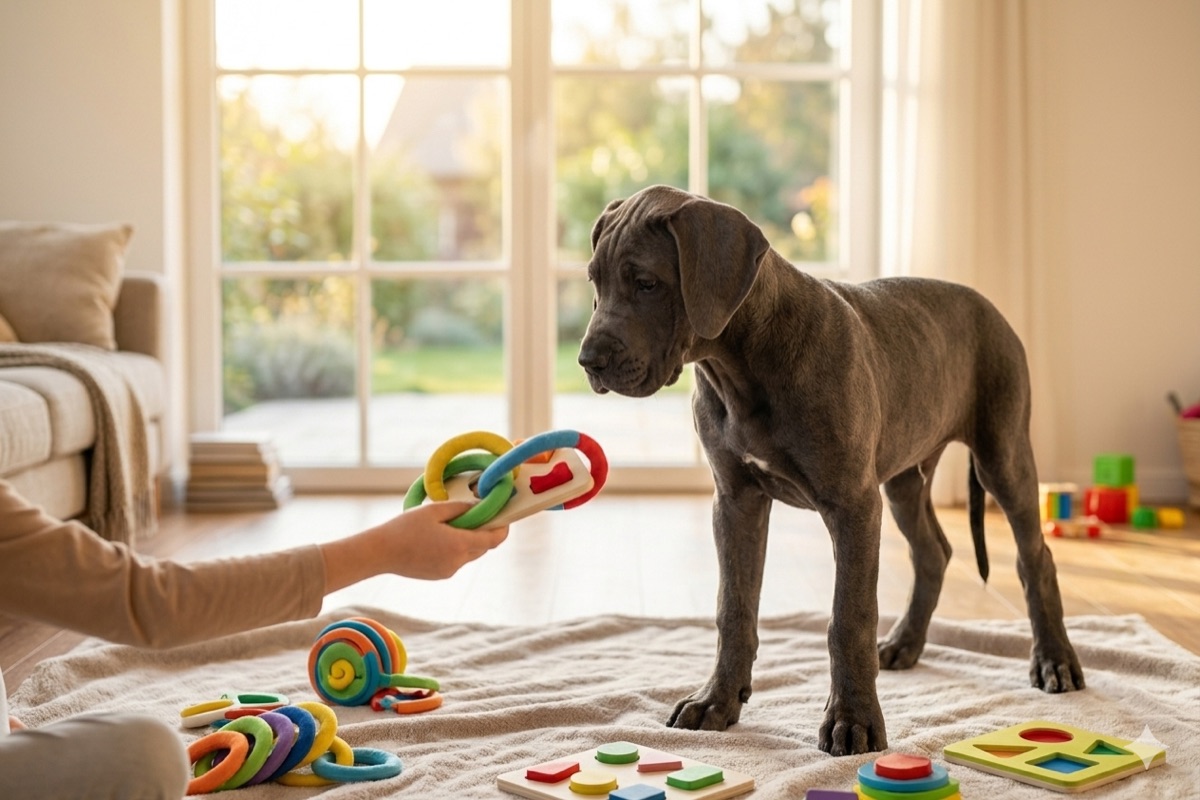
The first ninety days with a Great Dane puppy are unlike the first ninety days with any other dog, for one simple reason: the scale. You are not raising a puppy that will become a medium dog. You are raising a creature that may weigh more than you do by its first birthday, and the choices you make in these early weeks — how you feed, how much you let it leap and climb, how you socialise and house-train it — will echo across its whole, short life. Get this window right and you set the foundation for a calm, sound, well-mannered giant. Get it wrong and you can create problems that no amount of later effort fully undoes.
This is your settling-in roadmap, broken into the stretch that matters most. It assumes you have already done the hard work of choosing a responsible breeder; now comes the part where the dog is actually, gloriously, yours.
Before arrival: preparing the home
A Great Dane puppy starts deceptively small and grows with alarming speed, so prepare for the dog you are about to have, not the one stepping out of the crate today.
- Buy for now, plan for later. A tiny collar and a small crate make sense at first, but know that you will size up repeatedly — gear you outgrow is one of the real first-year costs of a giant breed. Many owners buy a large crate with a divider so it grows with the puppy.
- Bedding with traction. Giant-breed joints do not belong on slippery floors. Lay down rugs or runners on hard surfaces where your puppy will walk and play, to prevent the splayed-leg slips that strain developing joints.
- Puppy-proof at scale. Remember the reach of this breed. Counters, tables, and shelves you think are safe will not be for long. Secure rubbish, cables, and anything chewable.
- Stock the essentials: a large-breed puppy food (ideally the one the breeder is already using, to avoid a sudden switch), stainless bowls, a flat collar and a well-fitted harness, an ID tag, and safe chew toys appropriate for a powerful jaw.
The first week
Your puppy has just left everything it has ever known — its mother, its littermates, its breeder. The first week is about safety, routine, and lowered expectations.
Keep the world small at first. One or two quiet rooms, a predictable rhythm of meals, naps, and toilet trips, and plenty of sleep. Giant-breed puppies need enormous amounts of rest to grow; an over-tired Dane puppy is a cranky, nippy one. Resist the urge to throw a welcome party — the parade of excited visitors can wait a few days.
Expect some unsettled nights. A puppy used to sleeping in a warm pile of siblings may protest the first nights alone. A crate near your bed, a soft toy, and a consistent response will get you through faster than improvising differently every night.
And start as you mean to go on. The behaviours you find adorable in a 10 kg puppy — jumping up, mouthing hands, climbing into your lap — are a different matter in a 60 kg adult. Gentle, consistent boundaries from day one are a kindness to the dog you are about to have.
Feeding a giant-breed puppy
Nutrition is where new Dane owners most often go wrong with the best of intentions, so read this section twice.
A Great Dane puppy must be fed a food specifically formulated for large- or giant-breed puppies. This is not marketing. Large-breed puppy formulas are carefully balanced — particularly in calcium and overall energy — to support slow, steady growth. Standard puppy foods and many adult foods can push a giant-breed puppy to grow too fast, and rapid growth is directly linked to developmental orthopaedic disease.
A few principles:
- Don’t switch abruptly. Keep your puppy on the breeder’s food at first, then transition gradually over a week or so if you change it.
- Feed multiple small meals a day rather than one or two large ones, both to support steady growth and to reduce bloat risk.
- Don’t over-supplement. In particular, do not add calcium or “growth” supplements to a complete large-breed puppy diet unless a vet specifically directs it — excess calcium is harmful to developing giant-breed bones.
- Keep your puppy lean. A slightly lean, growing Dane is far healthier than a roly-poly one. You should be able to feel ribs easily. Carrying extra weight during growth is a direct load on immature joints.
The golden rule: controlled growth
If you take one principle from this entire guide, take this: with a giant-breed puppy, slower is safer. Their skeletons are growing at a breathtaking rate, and the growth plates remain soft and vulnerable for many months. Two forces threaten them — growing too fast (driven by diet) and impact (driven by activity).
You control the diet with appropriate large-breed nutrition, as above. You control impact with sensible exercise limits during the growth period:
- No forced or repetitive exercise while the puppy is growing — no jogging alongside you, no long demanding hikes.
- No jumping down from heights, and no stairs in the early months where you can avoid them. Carry small puppies on stairs where practical, or use a ramp; block access where you cannot.
- No slick floors for skidding and scrambling — back to those rugs and runners.
- Free play on good footing is ideal. Let the puppy potter, explore, and rest when it wants. Self-directed play on grass is far safer than structured, forced exercise.
These limits relax as the puppy matures and the growth plates close, but during these first months, restraint is protection.
Crate training and house-training
A crate, used kindly, is one of the best tools you have — a den that aids house-training, gives the puppy a safe place to rest, and keeps it out of trouble when unsupervised.
- Make the crate a good place. Feed meals in it, offer chews there, never use it as punishment. The goal is a puppy that chooses the crate.
- Right-size it. Large enough to stand, turn, and lie down; not so large the puppy can toilet at one end and sleep at the other. A divider in a big crate solves this as it grows.
- House-training is a numbers game. Take the puppy out frequently — after waking, after eating, after play, and on a regular schedule — and reward heavily the instant it goes outside. Accidents are management failures, not defiance; clean them without drama and tighten your supervision.
Consistency beats intensity. A predictable routine teaches a Dane puppy faster than any amount of correction.
Socialisation and early manners
There is a sensitive window in early puppyhood when positive exposure to the world shapes a confident adult temperament — and in a dog that will end up the size of a small pony, a confident, well-mannered temperament is not optional, it is essential. A frightened or reactive Great Dane is a serious handful; a calm, socialised one is a joy.
During these weeks, expose your puppy gently and positively to a wide variety of sights, sounds, surfaces, and experiences: different people, calm and vaccinated dogs, car rides, household noises, gentle handling of paws and ears and mouth. Keep every encounter low-pressure and rewarding; the goal is “the world is safe and interesting,” never “the world is overwhelming.” Balance this against your vet’s guidance on disease exposure before the vaccination course is complete — there are safe ways to socialise (carried outings, controlled meetings with healthy dogs) before a puppy is fully covered.
Begin basic manners now, in short, fun sessions: name recognition, sitting, coming when called, walking nicely, and gentle handling. Teaching loose-lead walking and “four paws on the floor” while your dog is small is far easier than retraining a fully grown giant who has learned that pulling and jumping work.
Vet care and bloat awareness
Within the first days, establish care with a veterinarian — ideally one experienced with giant breeds. Bring the breeder’s health records and set up the vaccination, deworming, and parasite-prevention schedule. Use this first visit to discuss giant-breed-specific topics: growth, nutrition, neutering timing (which for giant breeds is often recommended later than for small dogs, to let growth plates close), and bloat.
On that last point — every Great Dane owner must learn the signs of bloat (gastric dilatation-volvulus) from day one. It is a sudden, life-threatening twisting of the stomach and a true emergency where minutes matter. Learn the warning signs now — a distended, hard abdomen, unproductive retching, restlessness and obvious distress, drooling — and know your route to the nearest emergency vet before you ever need it. Talk to your vet about prevention, sensible feeding practices, and whether a prophylactic gastropexy is right for your dog.
Month-by-month at a glance
Every puppy develops on its own timeline, but here is a rough map of where your attention goes across the first three months.
Month one — safety and routine. Keep the world small. Establish sleeping, eating, and toileting rhythms. Begin crate familiarisation and the very first gentle handling. Settle in with your vet, confirm the vaccination schedule, and learn the signs of bloat. Most of all, let the puppy sleep — growth happens in the rest.
Month two — socialisation in earnest. As your vet clears more exposure, widen the world deliberately and positively: new surfaces, sounds, calm dogs, car rides, friendly people of all kinds. Layer in short, fun training sessions — name, sit, recall, loose-lead basics. Keep enforcing the controlled-growth rules; the puppy now feels sturdier than its joints actually are, which is exactly when owners get careless.
Month three — consolidation. Manners become habits. Reinforce house-training until accidents are rare, extend (gently) the focus of training sessions, and keep socialising — confidence built now pays dividends for years. Continue lean feeding and protected joints. By the end of this month you have a leggy adolescent who is unmistakably your dog.
A note that spans all three months: bonding is built through calm, positive handling, not constant stimulation. Quiet time together — gentle grooming, handling paws and ears, simply being near you — does as much for your relationship as any outing. A Great Dane that trusts your hands and your routine grows into the steady, leaning companion the breed is loved for.
One more thing worth saying plainly: a good breeder does not disappear the moment the puppy leaves. The best ones stay reachable for exactly these first months, ready to answer the small worried questions every new owner has — is this much chewing normal, is the puppy eating the right amount, should this lump or limp concern me. If you bought from a responsible breeder, lean on them; that ongoing support is part of what you paid for, and a breeder who welcomes your questions is one of the surest signs you chose well. (If you are still in the choosing stage, our guide on verifying a breeder before you pay covers exactly what to look for.)
Finally, keep a simple log during these weeks — weight, meals, vet dates, and any small concerns. With a fast-growing giant breed, a written record makes it far easier to spot a change early and gives your vet something concrete to work from. It takes thirty seconds a day and it is the kind of quiet diligence that catches problems while they are still small.
Ninety days will pass faster than you expect, and at the end of them you will have a leggy, half-grown, deeply bonded companion who has decided your sofa is a shared resource. The work of these first months is quiet and unglamorous — measured meals, careful footing, patient routines, gentle exposure to the world — but it is the work that buys you a sound, steady, confident giant for all the years to come. Few of them, sadly. So spend the first ninety days, and every day after, making each one count.