
If you remember one sentence from everything we publish, make it this one: the verification happens before the payment, never after. The moment your deposit clears, almost all of your leverage evaporates. Everything that follows in this guide is designed to be done while you still hold the most powerful card in the deal — the choice to walk away.
Choosing a Great Dane breeder is not like buying a product; it is closer to choosing the people who will shape the first, most formative weeks of your dog’s life. The difference between a responsible breeder and a careless one shows up years later in a heart murmur, a fearful temperament, or a hip that gives out early. So we vet hard, without apology. A good breeder respects you for it.
What a responsible breeder actually looks like
There is a wide spectrum between the dedicated, ethical breeder and the outright fraudster, and most disappointment lives in the murky middle: the well-meaning amateur and the volume-driven backyard breeder. Learning to place a seller on that spectrum is the core skill of safe buying.
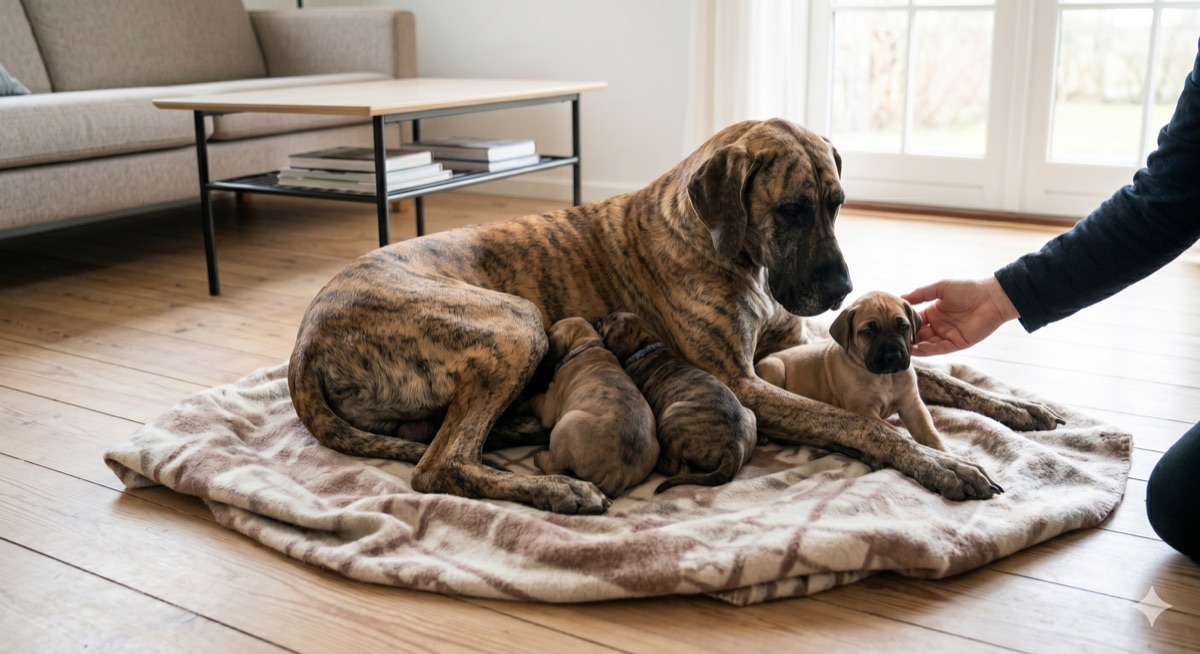
A responsible breeder treats their dogs as family and their litters as a serious responsibility. They breed selectively — a few carefully planned litters, not a constant supply. They health-test their breeding stock and can prove it. They raise puppies underfoot in the home, socialising them to ordinary household life. They ask you pointed questions about your home, your experience, your fencing, your hours, and your plans, because they intend to stay in this puppy’s life. And, tellingly, they will take a dog back at any point in its life rather than see it end up in a shelter.
A backyard breeder, by contrast, breeds for convenience or income with little regard for health screening or temperament. The dogs may be perfectly nice; the process is the problem. A puppy mill is that same indifference at industrial scale. And a scammer has no dogs at all — only stolen photos and a payment request.
Your job is to gather enough evidence to tell which one you are talking to. Here is how.
The paper trail: registration and pedigree
Start with documentation, because it is the easiest thing to verify independently and the hardest thing for a fraud to fake convincingly.
- Ask for the registered names and registration numbers of both the sire and the dam. A legitimate breeder provides these without hesitation.
- Verify them directly with the kennel club, not through any link or screenshot the seller sends you. National registries (AKC, The Kennel Club, FCI member clubs, and so on) let you confirm that the dogs exist and are registered as claimed.
- Understand what registration is and isn’t. Papers confirm pedigree; they do not certify health or quality. A puppy can be fully “registered” and still come from completely untested parents. Registration is necessary, but it is the floor, not the ceiling.
- Ask to see the pedigree itself. A breeder who knows their lines can talk you through three or four generations — who the dogs were, what they were like, what they were bred toward.
If a seller is evasive about registration numbers, claims the papers are “coming later,” or offers a vague “registered” with no body named, slow everything down.
Health testing you must confirm
This is where responsible breeding is won or lost, and it is the area scammers and amateurs most reliably fail. In Great Danes specifically, you are looking for evidence that the parents were screened for the conditions that genuinely threaten the breed: dilated cardiomyopathy and other cardiac issues, hip dysplasia, eye conditions, and thyroid disorders, at minimum.
The critical distinction: “our dogs are healthy” is a claim, not a test. Ask for the actual results — cardiac evaluations, hip scores, eye certifications, thyroid panels — with the testing body and date visible. A genuine breeder is proud of these and will share them readily. We break down each test, what the results mean, and what to ask for in our Great Dane health-testing guide.
Two warning signs to weigh heavily:
- No testing at all, dressed up as “the line has never had problems.” In a giant breed, that is not reassurance; it is a gap where the screening should be.
- A vet letter substituted for breed-specific screening. A general “healthy puppy” check from a vet is not the same as formal cardiac, hip, eye, and thyroid evaluations of the parents. Don’t accept one as a stand-in for the other.
The visit or live video call
Nothing replaces seeing the puppy with its mother in the environment where it was raised. When you can visit in person, do — watch how the dogs interact with the breeder, whether the space is clean, whether the dam is present and well.
When distance makes an in-person visit impossible (as with most imports), the live video call is non-negotiable. Insist on seeing:
- The specific puppy you are discussing, with the dam, moving in real time.
- The breeder doing something spontaneous on request — picking the puppy up, walking through the room, showing you the litter. This single step defeats nearly every photo-based scam, because a fraudster working from stolen images simply cannot produce a live, on-demand video of a dog they do not have.
A breeder who will trade endless photos but never appears on a live call is telling you something. Believe them.
The contract and guarantee
Before money moves, you should have a written contract in hand and have actually read it. A serious breeder’s contract typically covers:
- A health guarantee — what is covered, for how long, and what the remedy is if a genetic condition appears.
- Return clause — a commitment to take the dog back if you can no longer keep it, at any age. This is one of the clearest markers of an ethical breeder.
- Spay/neuter or breeding-rights terms, where relevant.
- Deposit and refund conditions — exactly what your deposit secures and under what circumstances it is returned.
- What happens on arrival if an imported puppy is found unwell.
No contract means no protection and no recourse. “We’ve never needed one” is not a feature; it is a risk you would be absorbing entirely on your own.
Red flags that should end the conversation
Some signals are serious enough on their own to justify walking away:
- Insistence on irreversible payment — wire to a personal account, cryptocurrency, gift cards, or peer-to-peer “friends and family.” (We explain why payment method is your strongest protection in our guide to buying and importing safely.)
- Refusal of a live video call.
- Pressure and manufactured urgency — “another buyer is waiting,” “send the deposit today.”
- Prices far below the realistic market for a health-tested puppy.
- Photos that appear elsewhere in a reverse image search.
- No questions for you. A breeder who doesn’t care who you are doesn’t care where the puppy goes.
- Multiple breeds and constant availability — a sign of volume breeding rather than careful planning.
One red flag warrants caution; two or more warrant goodbye.
The scam scripts you’ll actually hear
Fraudsters reuse the same scripts because they work on hopeful buyers. Recognising the words in advance strips them of their power. Here are the ones we see most often, and the reality behind each.
- “I just need a deposit to hold her — another family is asking.” Manufactured scarcity. A planned, well-run litter is not a clearance sale, and an ethical breeder would rather hold a puppy for the right home than rush it to whoever pays first.
- “We can only do bank transfer / crypto / gift cards for security reasons.” This is precisely backwards. Those methods are favoured because they are irreversible and untraceable — they protect the seller, not you. Genuine security comes from methods that give the buyer recourse.
- “The shipping company needs an urgent fee for a special crate / insurance / a refundable deposit.” The classic escalation. Real, accredited pet transporters can be contacted independently and have transparent, known costs. Fees that appear suddenly, demand urgency, and route through the seller are the scam itself.
- “I’m a missionary / on an oil rig / military overseas, so I can’t do a video call.” A sympathy story engineered to excuse the one thing that would expose them: live video of a dog they don’t have.
- “Our account details have changed — please send to this new account.” Invoice interception. Always confirm any change of payment details by a separate channel you already trusted, never by replying to the message that announced the change.
If the conversation starts following one of these scripts, you already know how it ends.
Frequently asked questions
Is it rude to ask a breeder for so much proof? No. The best breeders welcome it — your diligence signals that you’ll be a careful owner. Anyone offended by reasonable verification has told you something useful about themselves.
A breeder won’t let me visit. Is that automatically a scam? Not necessarily — biosecurity around a young litter and the realities of international distance are legitimate. But “no visit” makes a live video call absolutely essential, along with independently verified registration and references. No visit and no video is a hard stop.
How much deposit is normal? A modest deposit to reserve a puppy is standard practice; demanding the full amount up front, especially before health checks, is not. Pay deposits by a method that preserves your dispute rights, and get the terms in writing.
Can I trust a breeder with a beautiful, professional website? A polished site proves nothing — scammers build them daily, often with stolen photos. Judge by verifiable evidence (registration, health certificates, live video, references), not production values.
Your before-you-pay checklist
Print this, and don’t release a deposit until you can tick every box.
- Sire and dam registration numbers verified directly with the kennel club
- Breed-specific health testing (cardiac, hips, eyes, thyroid) seen as actual certificates
- Live video call completed, puppy seen with the dam in real time
- Breeder asked me substantive questions about my home and experience
- References from past buyers and/or the breeder’s vet obtained
- Written contract with health guarantee and return clause received and read
- Payment method chosen gives me dispute/reversal rights
- No high-pressure tactics; I never felt rushed
- Total cost (puppy + any import/transport) understood up front, in writing
Verification is not rudeness, and it is not distrust — it is respect for the seriousness of what you are taking on. The best breeders in the world will not merely tolerate this scrutiny; they will be glad of it, because it is exactly the scrutiny they wish every buyer applied. The ones who bristle, dodge, or rush you have just answered the only question that really mattered.